
Summary
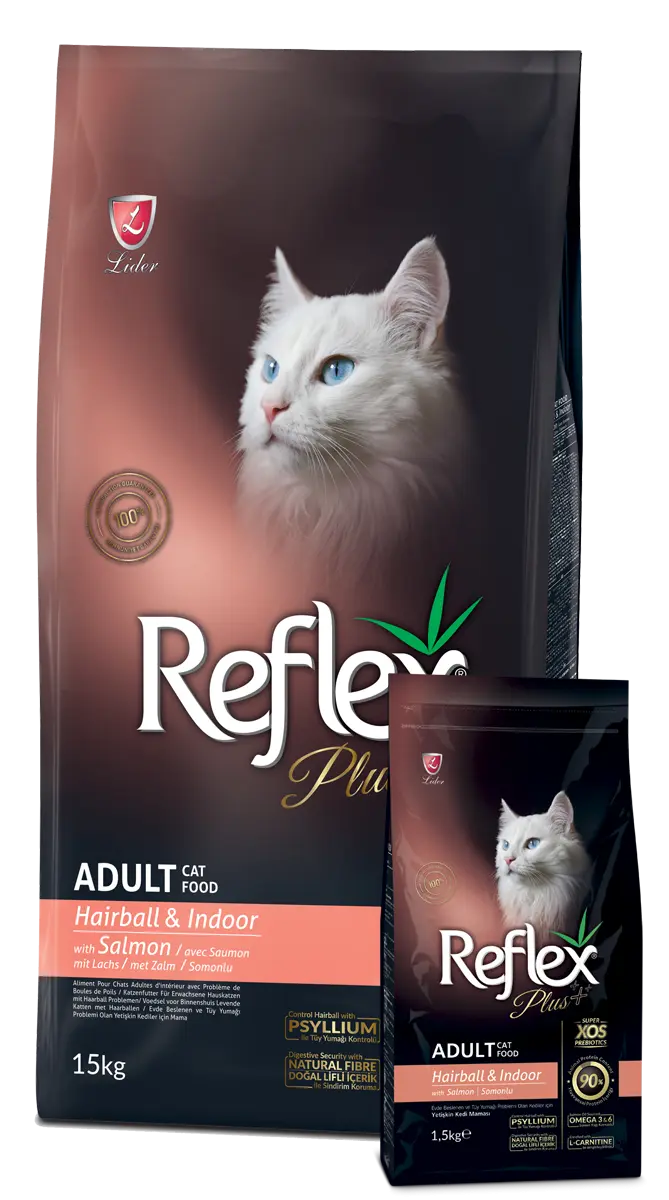
Reflex Plus Hairball & Indoor with Salmon is a dry cat food developed for adult cats prone to hairballs and living indoors.
The first ingredient is processed salmon protein, a rendered fish source providing a moderate-quality animal protein.
Processed animal protein appears next, though the specific animal source is not declared, which reduces transparency.
Corn and rice follow as primary carbohydrate sources, contributing to overall energy content but offering low digestibility for cats.
Chicken fat is the named fat source, preserved with synthetic antioxidants BHA (E320) and BHT (E321).
The formula includes psyllium, sugar beet, and sugar cane fiber to assist hairball movement through the digestive tract.
Salmon oil and brewers yeast provide functional benefits, including omega fatty acids and B-vitamins, respectively.
Pros:
Moderate protein content: Contains 34% crude protein (approximately 37.8% on a dry matter basis), supporting general feline maintenance needs.
Hairball-targeted fibers: Includes psyllium, sugar beet, and sugar cane fiber to aid in reducing hairball formation by improving digestive transit.
Defined fat source: Chicken fat is the main fat contributor, providing essential fatty acids for skin and coat health.
Salmon oil inclusion: Offers a natural source of omega-3 fatty acids, potentially supporting anti-inflammatory and skin health benefits.
Supplemented taurine: Taurine is included at 1,500 mg/kg, supporting vision and heart function in adult cats.
Cons:
Unspecified meat source: The inclusion of “processed animal protein” without identifying the species lowers transparency and could indicate use of mixed or lower-quality sources.
Carbohydrate-heavy: Corn and rice rank highly in the ingredient list, contributing to an estimated 28% carbohydrates on a dry matter basis, which is high for obligate carnivores.
Synthetic antioxidants: The use of BHA (E320) and BHT (E321) for preservation introduces chemical additives that are generally discouraged in premium feline diets.
No chelated minerals: The mineral additives are not chelated, which may reduce bioavailability compared to more advanced mineral formulations.
Single animal protein type: Only fish-based protein is specified, and with no poultry or other meats, the amino acid diversity may be limited.
Nutrition
Ingredients
- Processed Salmon Protein
- Processed Animal Protein
- Corn
- Chicken Fat
- Rice
- Sugar Cane Fibre
- Sugar Beet
- Fish Flavor
- Vitamins and Minerals
- Salmon Oil
- and also:
Vitamins and Additives
- Vitamin A 18000 IU
- Vitamin C 200 mg/kg
- Vitamin D3 1500 IU
- Vitamin E 200 mg/kg
- and also:
Guaranteed Analysis
Guaranteed Analysis
View the product change history.
Sellers’ Offers
Select Package size to view offers
More products from Reflex Plus
Sterilised Adult with Chicken
Adult Gourmet
Adult Cat Food with Lamb & Rice
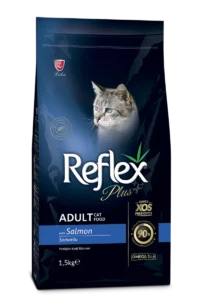
Adult Cat Food with Salmon
Adult Chicken

Kitten with Chicken
Alternative Products
We compare key factors such as overall score, life stage, and category, along with core nutritional values like protein, fat, fiber, and metabolizable energy.
While not identical, these products fall within a defined range to offer nutritionally comparable options.
Original - Sterilized Hairball

Adult Hairball Chicken
Sterilized Hairball

Adult Cats Hairball Control - Duck
Why this score?
- 33.3% carbohydrates of combination CR-27
- Low protein content-13
- By-product supplement meat ingredient at 2nd place-4

Found a mistake?
Missing info?
Provide as many details as possible about Reflex Plus: Hairball & Indoor with Salmon so we can make it better!
Thank you!
How the score is calculated?
The actual calculation of the score is based on sophisticated and advanced algorithm that takes into account multiple parameters.
To simplify the explanation, the calculation is based on three main criteria:
(1) Amount of protein (more is better)
(2) Amount of carbohydrates (less is better)
(3) Quality and source of ingredients.
Based on that 3 main criteria, 9 score calculation rules are used to compare the different foods.
One major assumption is that the closer an ingredient is to the top of the ingredient list, the greater its relative weight and contribution to the food.
In general, cat food is composed of protein, fats, carbohydrates, fibers, vitamins, and minerals.
Protein is the most important component in a cat's diet, and cats primarily get their protein from animal meat.
Fat is a primary source of energy and essential fatty acids.
Carbohydrates are controversial in a cat's diet, as cats are obligate carnivores and typically consume very few carbohydrates.
Fibers play an important role in digestion and food absorption, and vitamins and minerals are essential for different organism functions.
Dry matter values are used to compare the amount of nutrients in different cat foods. This means that moisture is excluded from the equation to provide a more accurate comparison.
Putting all of these and more into a formula results in a product score.
The maximum score a cat food can receive is 100. Points are added or removed based on the score calculation rules.
Didn't find a dry food?
Provide as many details as you can so we can analyze the missing product and add it.
Invalid form ID